Look beyond the shield footprint
A shield resists cave-in forces to protect workers inside. On a crowded site, its proposed location must also leave a protected way in and out without endangering adjacent foundations, pavements or utilities. The shield does not stabilize those structures. [1] [2]
A competent person inspects the excavation for hazards. A utility owner’s locating information, an engineer’s determination about a footing and the manufacturer’s limits for a shield answer different questions; none settles all three. [1] [2] [3]
Locate utilities before fixing the shield position
Remove or support hazardous surface obstructions. Before opening the excavation, determine the estimated locations of underground installations that could be encountered. Contact their owners within established or customary local response times and ask them to locate their installations. [2]
NIOSH recommends calling 811 before digging and using potholing to establish a line’s exact location and depth. As excavation approaches an estimated location, confirm the position by safe means. A line on a plan is not proof that the proposed shield clears it. [2] [4]
Check adjoining foundations and pavements
Under 1926.651(i)(1), support systems such as shoring, bracing or underpinning must be provided where the stability of adjoining buildings, walls or other structures is endangered by excavation. Excavation below the base or footing of a foundation or retaining wall that could pose a hazard is generally prohibited unless a support system is provided, the excavation is in stable rock, or a registered professional engineer approves a determination that the structure is sufficiently removed or the work will not pose a hazard. [2]
Sidewalks, pavement and related structures must not be undermined unless a support system or other protective method protects employees from collapse. A shield drawing gives the geometry of the box; it does not establish the stability of a nearby road edge. [1] [2]
Keep a protected route in and out
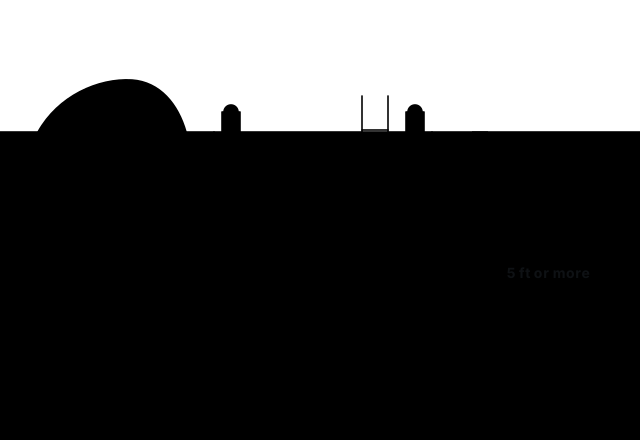
In trenches at least 4 feet deep, a stairway, ladder, ramp or other safe means of egress must be within 25 feet of lateral travel. Workers need cave-in protection while entering and leaving the shielded area. Check that the route still works when the box moves, and keep people out of it during installation, removal and vertical movement. [2] [3]
The shield must not carry loads beyond its design and must be installed to restrict hazardous movement. Compare the intended positions and fitted components with the data for the actual assembly. Where manufacturer’s tabulated data govern, a departure requires the manufacturer’s specific written approval. [3] [5]
Traffic and mobile equipment
Workers exposed to public vehicle traffic must be provided with and wear warning vests or other suitable high-visibility or reflectorized garments. When mobile equipment approaches or operates next to the excavation and the operator cannot see the edge clearly and directly, provide a warning system such as barricades, signals or stop logs. Where possible, slope the grade away from the excavation. [2]
NIOSH recommends planning machinery routes away from the trench and notifying other contractors about its location and precautions. A change in traffic flow or the operator’s view can make an earlier arrangement unsuitable. [2] [4]
Spoil and falling loads
Keep workers out from under loads handled by lifting or digging equipment and clear of vehicles being loaded or unloaded. Keep excavated material and equipment that could fall or roll in at least 2 feet from the edge, restrain them, or use both measures where needed. [2]
Loose rock or soil that could fall from the face needs its own protection, such as scaling, face barricades or an equivalent method. A shield does not control material rolling in from the edge. [2] [4]
Water, atmosphere and changing conditions
Employees must not work where water has accumulated or is accumulating without adequate precautions. A competent person must monitor water-removal equipment and operations. If the cut interrupts natural drainage, divert surface water away from it. [2]
Where oxygen deficiency or a hazardous atmosphere exists or could reasonably be expected, test the atmosphere before entry into an excavation greater than 4 feet deep. Where employee exposure is reasonably anticipated, a competent person inspects the excavation, adjacent areas and protective systems before work each day, as needed during the shift and after rainstorms or other hazard-increasing events. Remove exposed workers when hazardous conditions are found until the necessary precautions have been taken. [2]
Where shielding ends and support begins
The shield, the adjacent foundation and the buried utility pose different questions. A drawing for the shield cannot establish how either structure outside it should be supported. [1] [2] [3]
If a footing or utility could lose support as work advances, resolve that support question before relying on the shield position. The drawing may show that the box fits beside the structure; it cannot show that the ground beneath the structure will remain stable. [1] [2]
Where the shield design uses manufacturer’s tabulated data, keep the applicable written information, including any specific written approval for a deviation, at the jobsite while the system is constructed. A competent person must examine damaged protective equipment; if its suitability cannot be assured, remove it from service for evaluation and approval by a registered professional engineer before return. [3]
Sources
- 29 CFR 1926.650: Scope, application, and definitions applicable to this subpartOccupational Safety and Health Administration
- 29 CFR 1926.651: Specific excavation requirementsOccupational Safety and Health Administration
- 29 CFR 1926.652: Requirements for protective systemsOccupational Safety and Health Administration
- Preventing Worker Deaths from Trench Cave-ins (NIOSH Workplace Solutions 2011-208)CDC and NIOSH
- Steel Trench ShieldsPro-Tec Equipment