What a Steel Trench Box Does — and What It Does Not Do
A steel trench box is a shield. Its panels and spreaders form a structure intended to withstand cave-in forces and protect people within it. Protection does not extend to a worker simply because that worker is near the box. [1]
OSHA separates shoring from shielding. Shoring—metal hydraulic, mechanical or timber—supports excavation sides and prevents cave-ins; its vocabulary includes uprights, wales and cross braces. Aluminum hydraulic shoring is one type: OSHA describes an aluminum trench shoring assembly of aluminum hydraulic cylinders with vertical or horizontal rails. Those aluminum components belong to shoring, not to trench boxes. A shield—including a trench box—resists cave-in forces and protects employees within the trench, but it does not stabilize soil or replace site-specific selection and inspection. NIOSH lists sloping, benching, shoring and shielding as protective approaches; a competent person should select the system and ensure it is in place before workers enter the trench. [1] [4]
The three visible parts
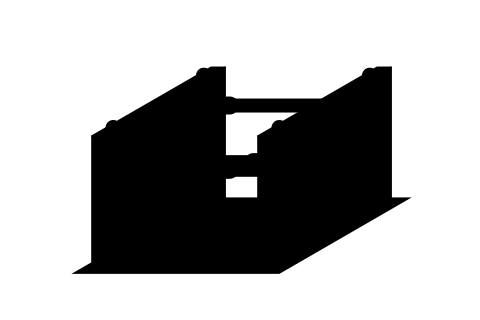
Follow one pipe across the drawing: the pipe is the spreader, the broad surface is the panel, and the short collar marks the area where they meet. A connection visible in this view identifies a part to look up, not a point from which to lift the box. [3] [5] [6]
The broad steel panels sit between the worker and the trench walls. Spreader pipes span the panels and maintain the working width. Where a pipe meets a panel, the model drawing may identify a collar, socket or bracket. That connection is not evidence of a lifting point. [6] [5]
A connection is not necessarily a lift point
Lifting is load handling, not a component label. OSHA requires that shield systems not be subjected to loads beyond those they were designed to withstand, and employees must not remain in the trench box while it is installed, removed or moved vertically. The same subpart bars employees from standing under loads handled by lifting or digging equipment, such as an excavator. Lifting belongs with the lift plan for the steel box and manufacturer instructions, not a conceptual sketch for a steel trench box. [3] [2]
GME's reference to D-rings for ease in lifting is a model-family label, not a category rule. A bar, ring, hole, collar or bracket on another steel box or on other trench boxes is not necessarily a lift point, and no bar or connection on the box should be assumed to have lifting capacity. No lift chart, machine configuration, sling arrangement or rigging plan is supplied for any named trench box. Those items must come from the equipment owner and manufacturer documents before an excavator or other machine lifts a steel trench box. [5] [3]
Pins and keepers
Pro-Tec says its engineer-stamped certification sheets state the required pipe arrangement and approved pins and keepers, and directs users to serialized tabulated data for the product. That data controls connection hardware for a steel trench box. A drawing of the trench box showing a steel cross member through a box panel does not identify the pin, keeper, collar or fastener approved for that internal connection on the box, nor does a hardware label such as iron or forged steel prove approval. The box drawing does not replace serialized data or trench-specific selection for the box. OSHA's manufacturer-data option requires installation in accordance with all manufacturer specifications, recommendations and limitations for the box; deviations require specific written approval. [6] [3]
Documents for the particular unit
For the actual unit, request the drawing and governing design data. Match the spreader arrangement, pins and keepers, and check handling features against the manufacturer’s instructions. Neither a family description nor a labeled sketch rates a lifting point. [3] [6]
Sources
- 29 CFR 1926.650: Scope, application, and definitions applicable to this subpartOccupational Safety and Health Administration
- 29 CFR 1926.651: Specific excavation requirementsOccupational Safety and Health Administration
- 29 CFR 1926.652: Requirements for protective systemsOccupational Safety and Health Administration
- Preventing Worker Deaths from Trench Cave-ins (NIOSH Workplace Solutions 2011-208)CDC and NIOSH
- 3M Trench ShieldsGME
- Steel Trench ShieldsPro-Tec Equipment