Why a Trench Box Is Not a Complete Safety Plan
A trench box protects employees inside it against cave-in forces within its design limits. It cannot keep water out, supply breathable air, or prevent a load overhead from falling. [1] [3] [2]
Shielding workers is not shoring the walls
Look at the two side panels and the members between them. They outline a structure that resists cave-in forces; they do not show a way out or tell us whether water is accumulating around the work. [1] [2] [3]
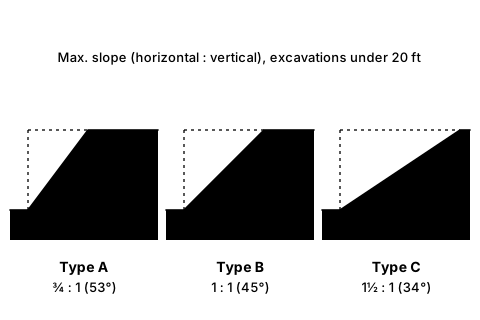
A shield is built to resist cave-in forces. Shoring, such as aluminum hydraulic shoring, supports the excavation sides to prevent cave-ins. Sloping and benching change the face itself. [1]
OSHA’s definition of protective systems includes support systems, sloping and benching, and shields. Section 1926.652(a)(1) requires an adequate protective system against cave-ins unless the excavation is entirely in stable rock, or is less than five feet deep and a competent person’s examination finds no indication of a potential cave-in. A trench box is one protective option, not the required choice for every excavation. [1] [3]
Working inside, entering and moving the box
Never subject a shield to loads beyond its design. Install it to restrict lateral or other hazardous movement under sudden lateral loads. [3]
Employees must be protected from cave-ins while entering and leaving the area protected by a shield. A trench 4 feet deep or more also needs a stairway, ladder, ramp or other safe means of egress within 25 feet of lateral travel. [3] [2]
No one may remain inside a shield while it is installed, removed or moved vertically. [3]
Excavation up to 2 feet below the shield is permitted only if the shield is designed for forces calculated for the full trench depth and, while the trench is open, there are no indications of possible soil loss from behind or below it. [3]
On the manufacturer-data route, follow all specifications, recommendations and limitations; a deviation requires the manufacturer’s specific written approval. Keep the written material at the jobsite during construction of the protective system. [3]
Accumulating water and runoff
Water accumulation is addressed on its own terms. Employees must not work in an excavation where water has accumulated or is accumulating unless adequate precautions have been taken. What is adequate varies by situation; the standard's examples include special support or shield systems, water removal to control the level, and a safety harness and lifeline. [2]
Where pumps or similar equipment control the water, the equipment and the operation must be monitored by a competent person to confirm proper operation. If work in trenches interrupts natural drainage, diversion ditches, dikes or other suitable means must keep surface water out and drain the adjacent area. [2]
Heavy-rain runoff requires another inspection by the competent person. A shield already in place does not establish that water precautions are adequate. [2]
Hazardous atmospheres
Atmospheric testing is triggered by expectation, not by the presence of a box. Where oxygen deficiency below 19.5 percent or a hazardous atmosphere exists or could reasonably be expected, such as in landfill areas or near stored hazardous substances, the atmosphere must be tested before employees enter excavations greater than four feet deep. [2]
Adequate precautions must then prevent exposure to oxygen-deficient or other hazardous atmospheres, including respiratory protection or ventilation under subparts D and E. Flammable gas must be kept below 20 percent of its lower flammable limit, and where controls reduce contaminant levels, testing must be repeated as often as necessary to confirm the atmosphere remains safe. [2]
Where hazardous atmospheres exist or could reasonably be expected to develop, emergency rescue equipment must be readily available and attended when in use. [2]
Utilities, Surface Encumbrances and Adjacent Structures
Surface encumbrances that create a hazard must be removed or supported. For underground installations, the estimated location of utilities such as sewer, telephone, fuel, electric and water lines must be determined before the excavation is opened, and utility companies or owners must be contacted within established or customary local response times and asked to locate them. [2]
If owners cannot respond within 24 hours, unless a longer period is required by state or local law, or cannot establish exact locations, the employer may proceed only with caution and only using detection equipment or other acceptable locating means. As work nears the estimated location, exact positions must be fixed by safe and acceptable means, and installations must be protected, supported or removed as needed while the excavation is open. [2]
Adjacent structures are a third question. Where adjoining buildings, walls or structures are endangered, support systems such as shoring, bracing or underpinning must protect employees. Excavating below the base or footing of a foundation or retaining wall that could reasonably be expected to pose a hazard is barred unless a support system is provided, the excavation is in stable rock, or a registered professional engineer approves a determination that the structure is sufficiently removed or that the work will not pose a hazard. [2]
Sidewalks, pavements and appurtenant structures may not be undermined unless a support system or another method protects employees from possible collapse. None of these requirements is met by the presence of a box in the trench. [2]
Falling Material, Mobile Equipment and Access Around the Shield
Loose rock or soil that could fall or roll from a face requires protection through scaling, barricades placed at necessary intervals to stop and contain falling material, or other means giving equivalent protection. The employer must keep excavated material and equipment that could fall or roll into the excavation at least two feet from the top edge, or use retaining devices, or both. [2]
No employee may be underneath loads handled by lifting or digging equipment, and each worker must stand away from vehicles being loaded or unloaded to avoid spillage or falling material. Operators may remain in the cab only where the vehicle is equipped to protect them under 1926.601(b)(6). [2]
Mobile equipment near the edge brings its own control. Where it operates adjacent to an excavation, or must approach the edge, and the operator lacks a clear, direct view of that edge, a warning system such as barricades, hand or mechanical signals, or stop logs must be used, and the grade should run away from the excavation where possible. Employees exposed to public traffic must wear high-visibility or reflectorized garments. [2]
Inspection and equipment condition
Daily safety inspection is a competent-person duty for contractors, covering the excavation, adjacent areas, protective systems and work in trenches. It occurs before work starts, as needed during the shift, and after every rainstorm or other hazard-increasing occurrence, where employee exposure can reasonably be anticipated. If evidence points to a possible cave-in, protective-system failure, hazardous atmosphere or other hazardous condition, exposed employees must be removed until precautions are taken. [2]
Equipment condition is checked in parallel. Materials and equipment for a protective system must be free of damage or defects that could impair function, and manufactured items must be used and maintained consistently with the manufacturer's recommendations. When a shield component is damaged, a competent person evaluates its suitability; if they cannot assure it can support the intended loads or is otherwise safe, it leaves service and will require a registered professional engineer's evaluation and approval before returning. [3]
Sources
- 29 CFR 1926.650: Scope, application, and definitions applicable to this subpartOccupational Safety and Health Administration
- 29 CFR 1926.651: Specific excavation requirementsOccupational Safety and Health Administration
- 29 CFR 1926.652: Requirements for protective systemsOccupational Safety and Health Administration